Tag: Spanish literature

Lorca’s Immanent Mysticism

This groundbreaking study places Lorca not only within a contemporary spectrum of Modernist production, but, more importantly, within the framework of a new mysticism for our time.

See details →

A Companion to the Spanish Picaresque Novel

Written by an international group of scholars, this edited collection provides an overview of the Spanish picaresque novel from its origins to the present day, along with a treatment of the debates that the picaresque has inspired.

See details →

A Companion to Calderón de la Barca

This Companion is the first comprehensive study of Calderón in English. It provides a rigorous but readable introduction to the man, his work and its legacy. Its chapters - written by leading international comedia specialists - provide an overview of his life, explain his intellectual, social, moral, and literary contexts, and examine his stagecraft, his corpus, and his reception both within and without the Hispanic world up to the twenty-first century.

See details →

Canciones: Federico García Lorca

With his boundless imagination, Tak's illustrations add a new depth and energy to Lorca's poetry. This collection will appeal to lovers of visual art, graphic novels and poetry and aims to bring the colourful and atmospheric landscape of Lorca's work to a new audience.

See details →

Literaturas entrelazadas

Literaturas entrelazadas. Portugal y España, del modernismo y la vanguardia al tiempo de las dictaduras estudia las estrechas relaciones entre las literaturas portuguesa y española desde finales del siglo XIX hasta mediados del XX.

See details →

Alfonso X of Castile-León

Today, the literary patronage of Alfonso X 'the Learned' of Castile (1252-1284) seems extraordinary for its time in the context of Europe. His cultural programme, which promoted his royal status and imperial ambitions, was hugely ambitious, and the paucity of information about the intellectual circumstances in which it took place magnifies the scope of Alfonso's achievements still further.

See details →

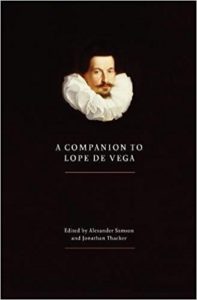
A Companion to Lope de Vega

A Companion to Lope de Vega brings together work by leading international scholars on the life and writing of Lope de Vega Carpio, the 'fénix de los ingenios', a 'monstruo de la naturaleza', as he was described by his rival, Miguel de Cervantes. Spain's foremost Golden Age playwright was in addition a major artist in prose and poetry, genres also covered by the Companion.

See details →